The Tragic Demise of Japan’s Constitutional War Constraints

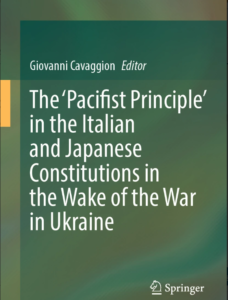
Published a chapter entitled “The Tragic Demise of Japan’s Constitutional War Constraints,” the in an edited volume, The ‘Pacifist Principle’ in the Italian and Japanese Constitutions in the Wake of the War in Ukraine, Giovanni Cavaggion ed., (Springer, 2026), which came out of the conference at the University of Milan last year. The full chapter is available on SSRN, and the abstract is below:

Article 9 of the Constitution of Japan famously prohibits the use of force and the maintenance of armed forces and “other war potential.” For seven decades this provision effectively shaped national policy, constraining the government from any use of force and, to a lesser extent, moderating Japan’s national security posture. It also helped define Japan’s postwar constitutional identity. This chapter examines the process and implications of how Article 9 has been illegitimately undermined over the last decade.

First, it explains the traditional understanding and effective operation of Article 9, from its first authoritative interpretation in 1954 through 2014. Second, it analyzes the Abe administration’s process of “reinterpretation” in 2014–2015, which gutted the clear and effective constitutional constraint on the use of force in paragraph one, and explains why this was not a valid informal amendment but an unconstitutional circumvention of the formal amendment procedure. Third, it examines how Russia’s 2022 invasion of Ukraine was used as an opportunity to complete the evisceration of Article 9, with a new national security strategy that entrenched the reinterpretation and sidelined the less effective prohibition on armed forces and other war potential.

The chapter closes with reflections on the tragic nature of this demise: Article 9 was a unique experiment in constitutional incorporation of international law constraints on the use of force. Its illegitimate subversion is significant not only for constitutionalism and the rule of law in Japan, but for the broader project of subjecting state use of force to meaningful legal limits—at a time when that project is under increasing strain internationally.


New Substack – Law in Crisis

I have launched a new substack, entitled Law in Crisis, which some might find interesting. As the masthead explains, it is a forum for “musings on how law can help our response to crises, and how to respond to the crisis in law itself – use of force and armed conflict, climate change and security, AI and security, constitutional and int’l human rights, and the rule of law more generally.”  The plan is to publish an essay of between one to two thousand words at least once a week.

Can Climate Trigger Armed Conflict? A Discussion with Ayesha Malik of Dawn News

It was a pleasure to discuss in a podcast with Ayesha Malik of Dawn News in Pakistan a range of climate change issues, and in particular the ways in which contributions to climate change, and particular responses to climate change, may contribute to the risks of armed conflict.

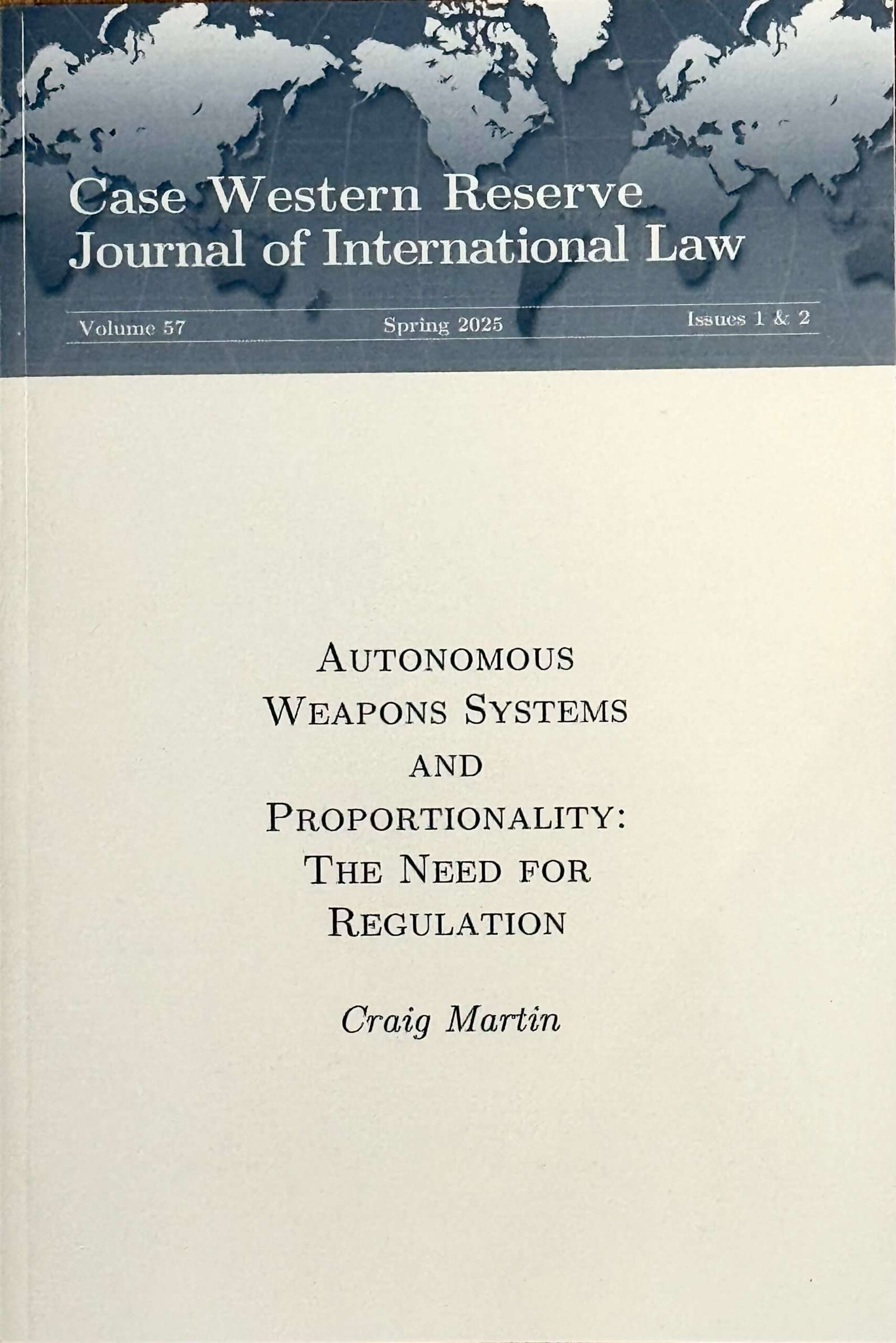
Autonomous Weapons Systems and Proportionality – New Article

Published a new law review article, “Autonomous Weapons Systems and Proportionality: The Need for Regulation,” in the Case Western Reserve Journal of International Law, Vol. 57:1 (2025). The full text is available for download at SSRN here, and the abstract is below:

This article examines the question of whether International Humanitarian Law (IHL) requires modification to effectively govern autonomous weapons systems (AWS). While extensive scholarly discourse has focused on whether AWS can comply with existing IHL principles, and whether the development and deployment of AWS should be constrained through weapons treaties, insufficient attention has been paid to why and how IHL itself might need adaptation to regulate AWS as a method of warfare. Given that the imminent development and deployment is unlikely to be prohibited, and that AWS may not comply with IHL in certain circumstances, the question of why and how IHL needs to be adjusted is important. The analysis focuses on the principle of proportionality as a means of exploring and illustrating the issue.

The article first traces the evolution of AWS governance debates, highlighting the impasse at the Convention on Certain Conventional Weapons (CCW) regarding constraints on AWS development. It then conducts a detailed examination of the distinct elements and operation of the principle of proportionality, a principle whose implementation demands complex, contextual, and sophisticated judgment.

The article examines the evidence of certain weaknesses of AI-operated AWS, explains why the operationalization of the principle of proportionality would present challenges for such systems, and argues that AWS would likely struggle to implement the principle reliably and predictably in certain operational contexts. The final section supports and defends proposals for the certain adjustments or modifications of IHL to better regulate AWS, thereby ensuring AWS operations remain constrained by the core principles of IHL. It ends by briefly exploring the mechanisms that might be available for developing such constraints.