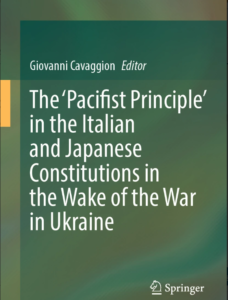
 Published a chapter entitled “The Tragic Demise of Japan’s Constitutional War Constraints,” the in an edited volume, The ‘Pacifist Principle’ in the Italian and Japanese Constitutions in the Wake of the War in Ukraine, Giovanni Cavaggion ed., (Springer, 2026), which came out of the conference at the University of Milan last year. The full chapter is available on SSRN, and the abstract is below:
Article 9 of the Constitution of Japan famously prohibits the use of force and the maintenance of armed forces and “other war potential.” For seven decades this provision effectively shaped national policy, constraining the government from any use of force and, to a lesser extent, moderating Japan’s national security posture. It also helped define Japan’s postwar constitutional identity. This chapter examines the process and implications of how Article 9 has been illegitimately undermined over the last decade.
First, it explains the traditional understanding and effective operation of Article 9, from its first authoritative interpretation in 1954 through 2014. Second, it analyzes the Abe administration’s process of “reinterpretation” in 2014–2015, which gutted the clear and effective constitutional constraint on the use of force in paragraph one, and explains why this was not a valid informal amendment but an unconstitutional circumvention of the formal amendment procedure. Third, it examines how Russia’s 2022 invasion of Ukraine was used as an opportunity to complete the evisceration of Article 9, with a new national security strategy that entrenched the reinterpretation and sidelined the less effective prohibition on armed forces and other war potential.
The chapter closes with reflections on the tragic nature of this demise: Article 9 was a unique experiment in constitutional incorporation of international law constraints on the use of force. Its illegitimate subversion is significant not only for constitutionalism and the rule of law in Japan, but for the broader project of subjecting state use of force to meaningful legal limits—at a time when that project is under increasing strain internationally.
 Mike Kelly and I continued our collaboration on AI issues, with an essay in Just Security entitled “