
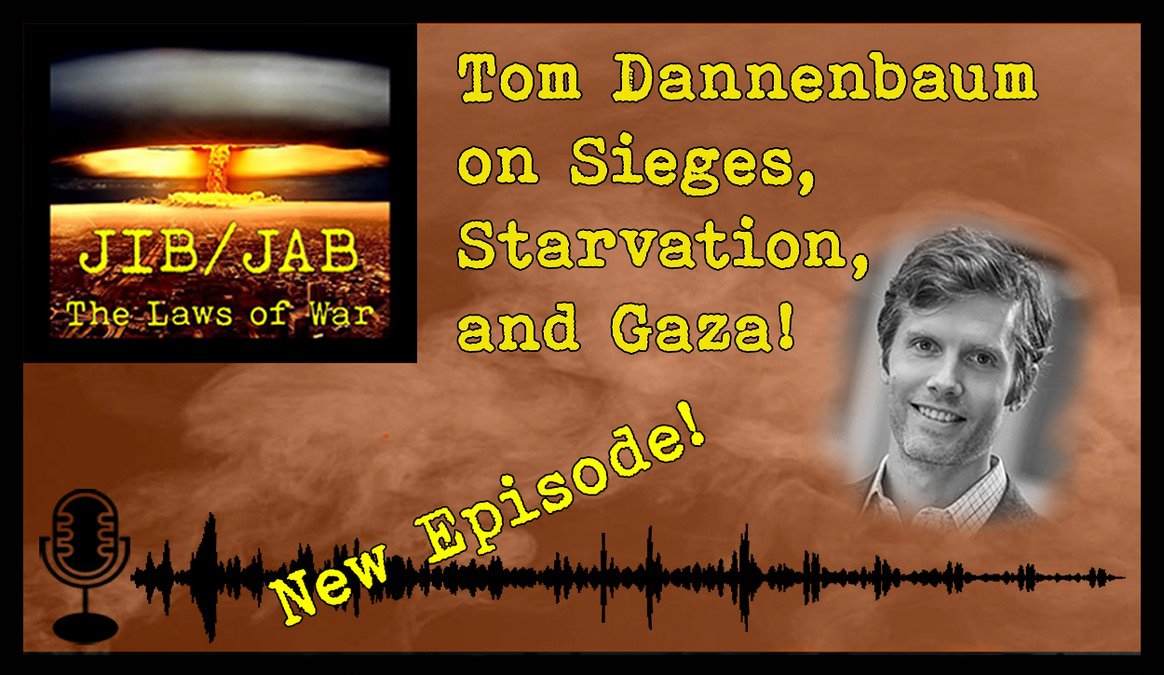
 It was good to get JIB/JAB-The Laws of War Podcast back on-line after an almost 7 month hiatus! Started the new season with a fantastic new episode on the issues of sieges, the war crime of starvation, and the siege of Gaza, with Tom Dannenbaum of the Fletcher School of Law & Diplomacy at Tufts University. The podcast has now been listened to almost 44,000 times in over 120 countries, so it feels like it is worth continuing, notwithstanding how much work it is!
use of force
Speaking to the CBC on the Gaza Conflict
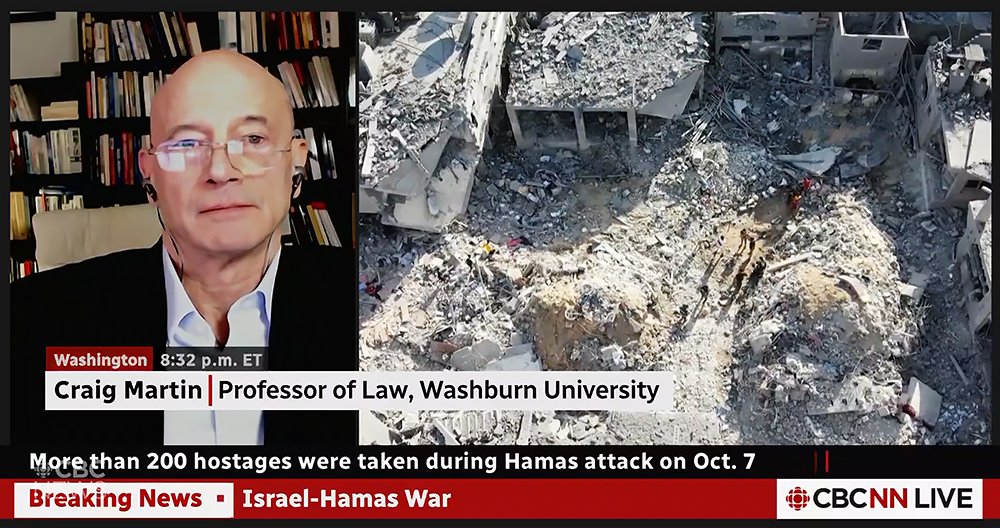 I was pleased that the media is reaching out to international law scholars to get explanations of the legal issues raised by the conflict in Gaza, and was happy to speak with the CBC’s Canada Tonight show on the topic despite how fraught the issues are, but I found it difficult to provide the necessary nuance or really explain the complexity of any of these issues in the short time provided. It is pity that there is not sufficient time to lay out the issues in a little more depth and sophistication. Some other media, such as Ali Velshi’s spot on MSNBC, have taken a little more time with experts to explain some of these issues more fully. It is important for the public to understand these issues better.
Canada’s ‘Royal Prerogative’ Allows it to Wage War Without Parliamentary Approval
(Published in The Conversation, Oct. 24, 2022).
 Questions are being raised again about how the Canadian government makes decisions to use force or participate in armed conflicts, prompted by reports that special forces units of the Canadian Armed Forces were operating on the ground in Ukraine.
While ostensibly deployed strictly for “training purposes,” such involvement can lead to more direct engagement in an armed conflict.
The decision to engage in armed conflict is one of the most consequential decisions a government can make. Who is involved in the decision-making, and what conditions or principles govern that process? Even more importantly, how should these decisions be made?
As a recent report suggests, the Ukrainian deployment has rekindled interest in these questions on Parliament Hill. But there should be a broader public discussion and debate.
Most Canadians would be surprised to learn that the prime minister and the cabinet have a far more unfettered power under the so-called royal prerogative to take the country to war than most other western democracies.
Early limits on war-waging powers
The modern idea that the power of the executive branch to wage war should be limited can be traced back at least as far as the Glorious Revolution in 1688, when English parliament placed constraints on the king’s ability to raise and maintain an army.
Climate Change and Global Security: Framing an Existential Threat
(Published in American Journal of International Law: Unbound, Aug. 15, 2022).
 Abstract: Should the climate change crisis be framed in security terms? Many argue that it is dangerous to treat non-military threats as security issues. Such “securitization” is associated with the expansion of executive power and the exercise of exceptional measures involving the suspension of individual rights, secrecy, state violence, and a weakening of the rule of law. Nonetheless, climate change has already been identified as a security issue by many government agencies and international institutions. But, as Benton Heath explores in “Making Sense of Security,” the very concept of security is both ambiguous and contested. There are different and competing ideas about what it means, when and by whom it should be invoked, the kinds of law and policy responses it should trigger, and, crucially, who gets to decide these questions.
Heath argues that differing approaches to security reflect deeper struggles over whose knowledge matters in identifying and responding to security threats. He develops a typology for assessing these different approaches, and the implications they have for international law and institutions. But, while he notes that climate change is precisely one of those issues around which there are competing security claims, he leaves to others the question of whether, or how, to frame climate change in security terms.
This essay takes up that question, continuing the inquiry into how best to understand the concept of security, and how Heath’s typology helps think about the question. It argues that it may indeed be important to frame climate change in security terms, but as a matter of global security rather than national security.