Archive for May, 2008
Canadian Charter Extended to Guantanamo Bay
Canadian Supreme Court Repudiates the Legal Black Hole Paradigm
The Supreme Court of Canada handed down a judgment relating to detainees in Guantanamo Bay on May 23, holding that the one Canadian detained there may rely upon the Canadian Charter of Rights and Freedoms to obtain some due process protection from the Canadian government.
Overview
The decision has already been reviewed briefly from the perspective of Canadian constitutional law on the University of Toronto and Osgoode Hall law school blogs, so I will not repeat that process here. But the decision has importance from the perspective of international law, and the relationship between international and constitutional law.
I would suggest that the judgment refutes the arguments, voiced most
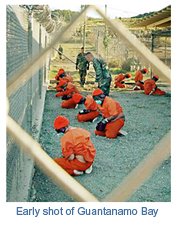
recently by several scholars at the ASIL conference in April, that there are circumstances in the so-called “war on terror” in general, and the treatment of detainees in particular, in which neither constitutional law or international law (whether human rights or humanitarian law) ought to govern the conduct and procedures of the detaining forces.
The Supreme Court held that it is precisely when the agents of the Canadian government participate in conduct and circumstances that constitute violations of international law, that the application of the Charter will be triggered and its protections available to detainees (or at least Canadian detainees - more on that distinction below).
Background
Omar Khadr was 15 years old when he was captured by U.S. forces in Afghanistan in July, 2002. He was one of the few detainees who has been arraigned and who is actually moving towards a trial before the much-disputed Military Commissions in Guantanamo Bay. He has been charged with murder and with conspiracy to commit other acts of murder and terrorism. The murder charge arises from the death of a U.S. soldier during the skirmish in which he was captured. Read the rest of this entry »

U.S. Missile Strikes in Somalia and the Laws of War
As was reported in the New York Times and elsewhere on May 2, the U.S. fired at least four Tomahawk cruise missiles into Somalia, striking a compound in the town of Dusa Marreb, killing at least ten people.
One of them, the primary target of the attack, was an alleged Al Qaeda operative named Aden Hashi Ayro, who was suspected of having killed a BBC journalist among other things. He was reported to be a notorious terrorist.
Several blog posts have noted the lack of mainstream discussion on the legality of this missile strike. Prof. Marty Lederman, writing in Slate, suggested that few seem to care whether it was legal. But even among the bloggers, the majority of posts I have seen, as in the case of Prof. Lederman’s, have focused primarily on the constitutional issues of whether the President had sufficient authority, explicit or otherwise, to launch such attacks. There has been some discussion of the jus in bello issues, such as whether the strikes met the criteria of military necessity and proportionality, given the apparent collateral damage. But few have addressed the jus ad bellum issues - was this missile strike, and those prior to it (there have been several such attacks on Somalia since 2006) lawful under the international laws on the use of armed force?
Developments in jus ad bellum?
Prof. Jullian Ku was one of few that has raised the issue, on Opinio Juris, but he merely floated the idea that since such strikes have met with little objection, they may be evidence that the U.S. is operating in a legal paradigm that approximates that of war. Implicit in this is the proposition that there have been developments in international law on the use of force since 9/11 that permit one to wage war on organizations, and which give the global “war on terror” a legal foundation that would permit such strikes against Al Qaeda operatives at large in a “failed state”.
As I commented on his post over at Opinio Juris, I question whether the fact that there has been little formal objection to the strike can be said to support the inference that the strikes were therefore lawful or justifiable under international law, or that it reflects developments in international law that permit such strikes. Read the rest of this entry »
U.S. Interference in Japanese Constitutional Case
There was a remarkable discovery announced just this week, that documents uncovered in American archives reveal that the U.S. ambassador to Japan in 1959 actively interfered in the judicial process regarding the determination of a fundamental constitutional issue. While the discovery has been widely reported in Japan, the context and significance of the issue deserve to explored in more depth.
The case in question, commonly known as the Sunakawa case, remains a highly important judgment of the Supreme Court, and the discovery that the U.S. government interfered in the process is important, and may have political repercussions in the ongoing constitutional revision debate.
The Telegram
The discovery itself was made by a Japanese historian on U.S. Japanese relations named Niihara Shoji. While doing research at the U.S. National Archives he uncovered a telegram from ambassador Douglas MacArthur II, nephew to the more famous general who was Senior Commander Allied Powers during the occupation of Japan. In the telegram, sent to Washington in April, 1959, ambassador MacArthur recounted his discussions with both foreign minister Fujiyama Aiichiro, and with Supreme Court Chief Justice Tanaka Kotaro, regarding the ruling by the Tokyo District Court in March, 1959, that the U.S.-Japan Security Treaty was unconstitutional, and that the maintenance of U.S. armed forces in Japan was a violation of Article 9 of the Constitution.
The telegram explains that ambassador MacArthur had initially pressed foreign minister Fujiyama to ensure that the government would appeal the decision directly to the Supreme Court, by-passing the more normal procedure of appealing to the Tokyo High Court. According to the telegram, he “stressed importance of GOJ [government of Japan] taking speedy action to rectify ruling by Tokyo District Court”.
It also recounts how he then had private discussions with Chief Justice Tanaka, after the Supreme Court was seized of the case, in which he sought to determine when the Supreme Court would likely hand down its decision. While the telegram is apparently silent on the issue, it is difficult to believe that the ambassador would not have similarly conveyed to the Chief Justice the American view that it was essential to “rectify” the ruling of the court below. Read the rest of this entry »
The article has
one response