
 It was a pleasure to be a guest at Deakin Univ. Law School’s Centre for Law as Protection, presenting my paper Geoengineering Wars and Atmospheric Governance at a seminar workshop, and participating in the Centre’s year-end symposium, discussing challenges confronting international law. Huge thanks to Shiri Krebs for the invitation! Melbourne, Australia, Dec. 10 and 12, 2024.
Uncategorized
ABILA Panel on the President as a Threat to National Security

Moderating a panel at ABILA (American Branch – International Law Association) annual conference on the President as a Threat to National Security, a discussion of Harold Koh’s new book The National Security Constitution in the 21st Century, with Harold Koh, Rebecca Ingber, and Karen Greenberg, at Fordham Law School, New York, Oct. 25, 2024.
Presenting at College Militaire Royal de St. Jean
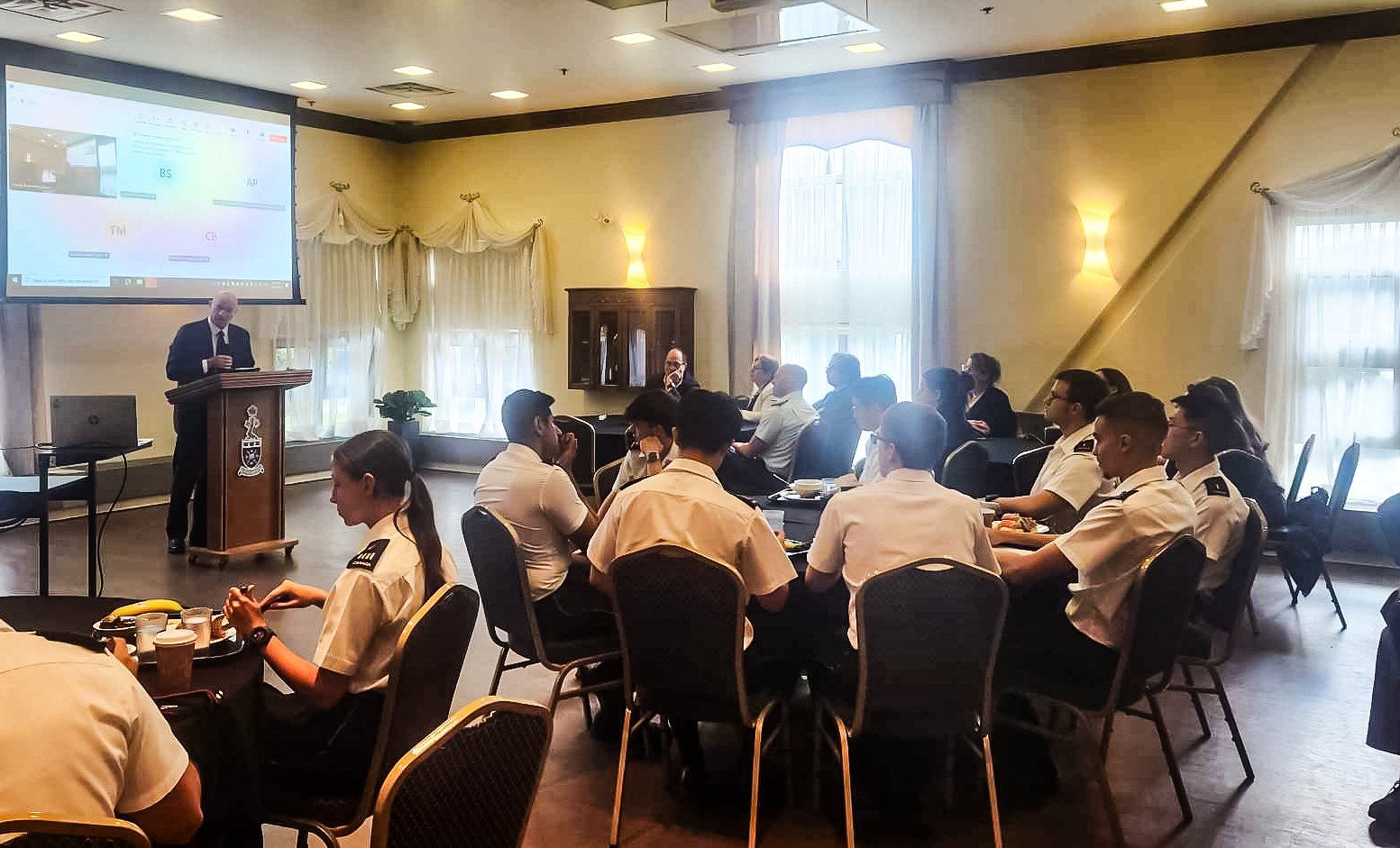 It was a real pleasure to return to College Militaire Royal de St. Jean, to present my paper Geoengineering Wars and Atmospheric Governance to the faculty, officers and cadets of the College over lunch, Oct. 7, 2024
On Iranian Gunboats: Beware Conflating American and Mainstream Views of the Law
(Published in Just Security, Jun. 2, 2020)
 In a recent essay in Just Security entitled “Iranian Gunboat Harassment and the Rules of Engagement,” Michael Schmitt and Durward Johnson explore important questions raised by President Trump’s recent instruction to destroy any Iranian gunboats that harass U.S. warships in the Persian Gulf. It is a thorough and careful analysis, and I agree with its conclusions – namely, that the harassing actions in question did not rise to the level of an imminent or actual armed attack on U.S. vessels, and thus could not justify a use of force in response, and that the president’s statements could in turn constitute an unlawful threat to use force in violation of Article 2(4) of the U.N. Charter. But the essay also raises some interesting and debatable questions that invite further discussion, and it makes assertions about the state of particular principles of international law that require some push-back. Let us begin with the latter.
The State of the Law: The Law of State Responsibility
The authors identify their purpose as assessing whether U.S. warships have a right under the body of international law that governs the resort to force by states (jus ad bellum), to use force in self-defense against Iranian gunboats engaged in harassment operations. At the very outset, in laying the foundation for the jus ad bellum analysis, the authors state that “as a matter of law, self-defense is a ‘circumstance precluding wrongfulness’ of a state’s use of force that would otherwise violate the prohibition found in Article 2(4) of the U.N. Charter…”